 Menu
Blood alcohol content (BAC) is the amount of alcohol in a person’s blood. It is measured by milligrams of alcohol per 100 millilitres of blood, and expressed as a percentage. For example, if a person’s blood alcohol concentration is .08%, they have 80 milligrams of alcohol per 100 millilitres of blood.
When your blood alcohol level is .08 or above, it is a criminal act to operate a motor vehicle. However, a blood alcohol level well below .08 will have predictable negative effects on your ability to drive. A level as low as .02 reduces your ability to track a moving object such as other cars or pedestrians, and reduces your ability to divide your attention between two tasks. If your blood alcohol reaches .05 you will also have reduced coordination, difficulty steering and a reduced ability to respond to an emergency situation. (Source – MADD)
The law recognizes the varying levels of impairment caused by progressively higher levels of alcohol in your blood. The legal consequences of driving under the influence of alcohol depends in-part on the amount of alcohol in your system.
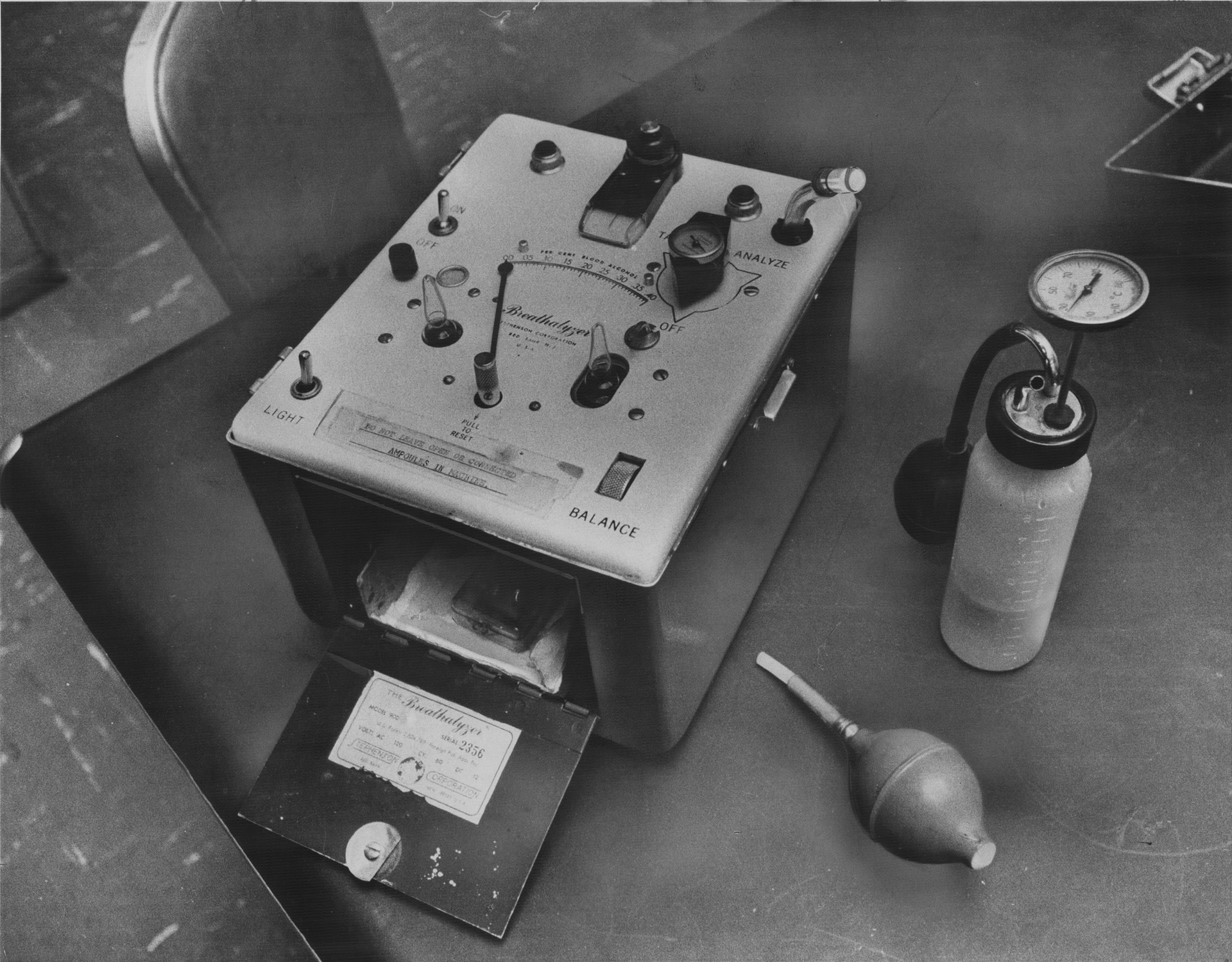
Fig. 2.
A breathalyzer, 1969.
Robert Borkenstein, a former Indiana state police captain, invented the modern breathalyzer in 1953. An improvement from earlier inventions such as the Drunkometer, the Intoximeter, and the Alcometer, the breathalyzer was easy to use and more accurate. This paved the way for police to determine if a driver was over the legal limit.